
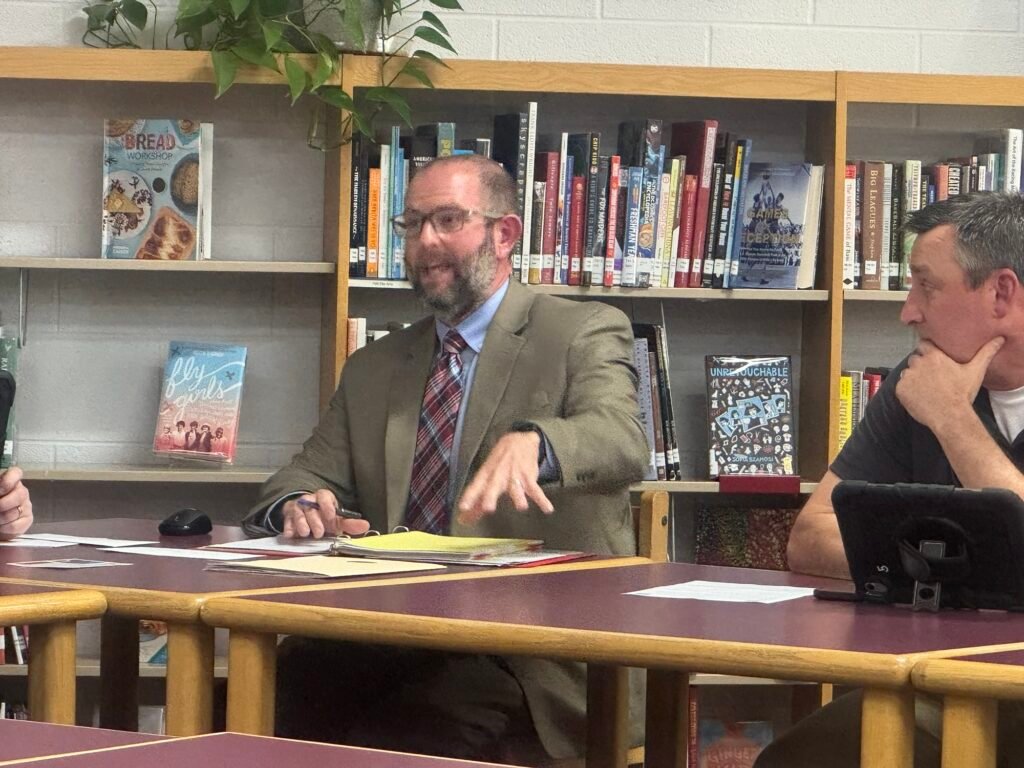
McKENZIE, Tenn. — “Unfortunately, we’re not feeling very good about South Carroll tax bill,” said Director of Schools Dr. Justin Barden at McKenzie Special School District’s board meeting Tuesday night, April 7.
Barden explained that despite initial optimism about legislation that would keep the district from losing more than $120,000 annually in sales tax revenue to South Carroll Special School District, the bill seems to have stalled in the Tennessee House of Representatives.
The Legislation
Senate Bill 2188 and House Bill 2388, sponsored by Senator John Stevens and Representative Brock Martin respectively, would change how Carroll County distributes local education sales tax revenue among its six school districts.
The bills propose counting only students whose primary residence is in Carroll County for local sales tax distribution purposes, excluding the 600-plus out-of-county students enrolled in South Carroll Special School District’s statewide virtual academy.
“Initially we felt good about it because Senator Stevens, Representative Darby and Martin, understood [the impact],” Barden told the board. “But it’s basically, as best we can tell, the Senate has continued to push forward with it. The house is really where it stalled.”
The Senate has moved the legislation onto the calendar for passage, but it has not moved beyond the K-12 Education Subcommittee in the House.
Potential AG Review
Representative Darby indicated to Barden that the bill was being reviewed by the Tennessee Attorney General’s office.
Education Committee Chairman Mark White (R-Memphis) indicated to South Carroll that the bill may be unconstitutional.
The potential legal review could involve questions about whether South Carroll can be prevented from counting its virtual students in the local funding formula, though the specifics remain unclear.
Carroll County Observer has reached out to a number of state lawmakers and district officials to get a complete understanding of the review and implications.
Targeted Legislation
The legislation has drawn criticism for singling out South Carroll, specifically.
In their February school board meeting, South Carroll Director of Schools Dr. Lisa Norris told her board that the bills were written specifically to impact their district.
“The bill is targeted toward us,” Norris said. “It’s written for Carroll County, for one school who has virtual programs, and that’s us.”
Norris has proposed an alternative solution where the Tennessee Department of Revenue would collect sales tax from virtual students’ home counties and distribute it to South Carroll based on where students actually reside, allowing “the money to follow the child.” However, that proposal has not been incorporated into the current legislation.
Financial Impact on McKenzie
The failure of the legislation would allow the current sales tax distribution formula to continue, meaning more than $120,000 of funding could be reallocated from McKenzie Special School District to South Carroll Special School District based on enrollment numbers.
The issue arose during budget planning earlier this year when Finance Manager Brad Davis flagged an unexpected reduction in projected sales tax revenue. South Carroll’s enrollment jumped from approximately 300 students to over 900, with virtual students making up almost all of that growth.
When those out-of-county virtual students are counted in the enrollment formula used to distribute Carroll County’s approximately $5 million in annual local option sales tax revenue for education, it changes each district’s share such that South Carroll could receive more than $300,000 in funding from local sales tax revenue.
Collectively, the other five Carroll County school districts would share a loss totaling $388,538.
“That can impact us this year and certainly impact us to a larger extent in the coming years,” Barden said.
What Happens Next
With the legislative session expected to close at the end of April, time is running out for the bills to advance.
Barden told the board the district will continue monitoring the situation, but acknowledged the outlook appears grim.
“We’re just not not feeling good about it at this point,” he said.
If the legislation fails, McKenzie and other Carroll County districts will need to account for the reduced sales tax revenue in their budgets. For McKenzie, which recently tabled a property tax increase proposal in February, the loss compounds existing budget challenges.
The district faces a projected deficit of $434,000 for the upcoming year without making cuts or raising revenue.
McKenzie’s board is scheduled to hold a budget work session June 8 with final budget adoption planned for late June.