

I went to jail today.
Let me explain.
Last night, I was in my office writing about Huntingdon’s council meeting when I received a text message from Chief Deputy Joel Pate with Carroll County Sheriff’s Office saying he would be glad to give me a tour of the jail, so I could see first-hand the conditions in which Austin Drummond experienced during his stay at Carroll County Jail.
Earlier in the day, the county had denied my records request for surveillance footage depicting Drummond’s detention there during his attempted murder trial.
I accepted without hesitation. It felt like a gracious offer and a welcome display of transparency on the part of Pate and the Sheriff’s Office to let me see inside the facility.
Booking in
Before going through, Pate instructed me that photographs were not allowed. So, I towed my camera along with the lens cap firmly in place.
Pate, along with Jail Administrator Thomas Williams and Lt. Jason Edwards walked me through the intake process that every inmate undergoes, whether they’re booked in after an arrest, book themselves in under a court order, or are transferred from another facility.
We started in the sally port, a garage with bay doors on both ends. Once a cruiser pulls in with someone bound for the jail, the bay doors close before the inmate is escorted inside.
Once inside, an inmate must step into a body scanner. The technology isn’t unlike the scanners used at airport security. Williams said the scanners have turned up contraband ranging from drugs to weapons, and staff told me it’s rare for something to slip past the machine undetected.
From there, they showed me what appeared to be a storage area with a bathroom and shower tucked away, where inmates are required to shower before being taken back into the facility. Pate pointed out a list of items every inmate receives upon intake: two uniforms, socks, two white T-shirts, a pair of shoes, a mat, a blanket, a cup, a spork, a mesh bag, a Bible, and personal hygiene items, among other things.
According to Pate and Williams, Drummond was provided all of those items before being taken to his cell.
The holding cell
The holding cell where Drummond stayed is a narrow, all-concrete room with two concrete benches running along the long walls.
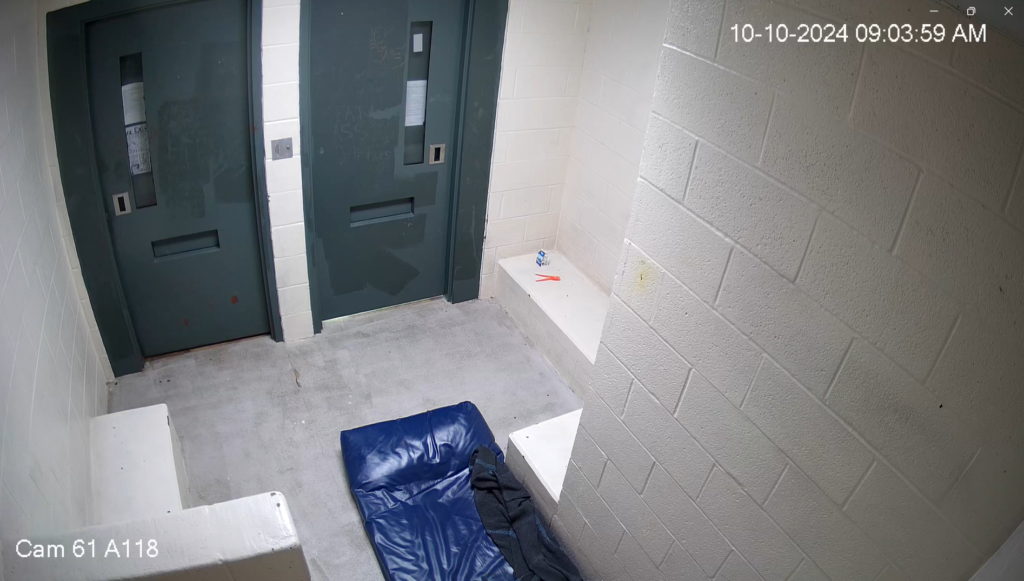
There are no windows. The only thing on the white wall is a little button and speaker by the door. An inmate can press that button to call upon a correctional officer outside.
Each concrete bench sits a little more than a foot off the floor and is narrower than the mat inmates are issued.
Seeing it, it’s understandable why an inmate might choose to put the mat on the floor and sleep there instead of on one of the benches.
The bench on the left-hand side ends at a half wall, behind which is a combination toilet and sink.
The lights in the holding cells stay on 24/7.
Staff said that the lighting in the cells runs on the same circuit as the hallway and booking area, where corrections officers work. Turning off a cell’s light would require turning off the lights in the area where COs are stationed.
Pate said Drummond’s stay was something of a unique circumstance that doesn’t typically happen in Carroll County. Precautions had to be taken regarding Drummond’s own safety that made holding him in general population out of the question.
“He had zero complaints. Zero,” Pate told me.
Pate said that Drummond’s requests were few — a razor to shave with and some hygiene items — and all were provided.
According to staff, Drummond was not treated any differently than anyone else brought into the jail. Placing him in a holding cell was the only option, given the safety measures that had to be taken.
“He had to be kept separate,” Pate said. “We had to take precautions to make sure he was safe.”
The rest of the facility
After leaving Drummond’s cell, they showed me around the rest of the jail.
We walked past the kitchen, where female inmates were cooking under staff oversight. Hamburger patties steamed on the flat-top grill while they prepared other items.
Next was the laundry area, which has two industrial washers and two industrial dryers.
They showed me one of the jail’s two suicide-watch cells and the quarantine pod. The nurse’s pod was off-limits during my visit, since inmates were being seen inside.
They took me through both the male and female general population areas.
Both are open, with a common area on the ground floor and cells above; inmates appeared to move freely throughout.
They then took me upstairs to the control room, sometimes called the “watch tower,” which has windows overlooking much of the facility, including windows in the floor that look down into the suicide-watch pods.
Inside, a corrections officer watches security monitors.
Tier One certification
Pate said the jail earned Tier One certification from the state in December, which is a standard met by only a handful of Tennessee jails.
To qualify, detention facilities must meet a number of standards, including offering a life skills or behavioral health program, an education program, maintain updated written policies and inspection reports, and have a training plan that includes leadership and verbal de-escalation training.
Pate said the certification qualifies the jail for an additional $6 a day for each state inmate housed at the facility. Carroll County Jail typically holds between 60 and 90 state inmates at a time.
A caveat
As far as jail conditions go, I have no experience of my own from which to draw conclusions. My hour inside during a guided tour does not compare to someone’s actual day-to-day experience living inside the facility.
I thank Chief Deputy Joel Pate for reaching out, as well as Thomas Williams and Lt. Jason Edwards.

Obviously they didn’t show you 32 north or south